




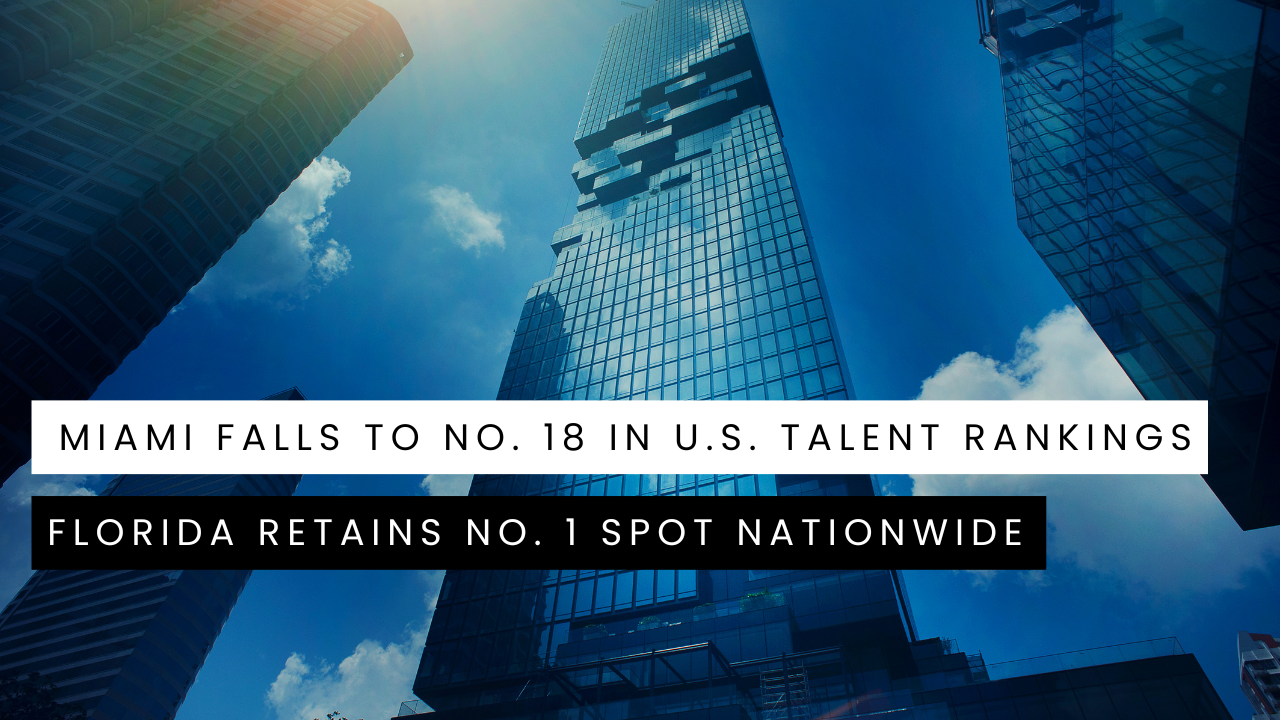
Lightcast’s 2026 Talent Attraction Scorecard places Florida first nationwide for the second consecutive year, even as Miami experiences a sharp decline in its metropolitan ranking.
Florida has retained its position as the nation’s leading state for talent attraction, but Miami’s standing among major metropolitan areas has fallen significantly, according to the 2026 Talent Attraction Scorecard released by labor market analytics firm Lightcast on October 26.
The annual report ranks Florida first among all 50 states for the second consecutive year, followed by Texas and Idaho. Arizona and Nevada complete the top five.
Miami, meanwhile, dropped from second place in the previous year’s large metropolitan rankings to No. 18 in 2026, marking one of the more notable shifts among major U.S. employment markets.
The contrasting results highlight differences in regional workforce performance within Florida, where several other metropolitan areas improved their national standings.
Miami Falls While Other Florida Metros Gain Ground
Although Miami remains among the top 25 large metropolitan areas in Lightcast’s rankings, its decline contrasts with stronger performances elsewhere in Florida.
Orlando-Kissimmee-Sanford ranked fifth nationally among large metropolitan areas, behind Austin, Dallas-Fort Worth, Raleigh and Phoenix.
Other Florida markets also performed well, including North Port-Bradenton-Sarasota, Lakeland-Winter Haven and Tampa-St. Petersburg-Clearwater, which placed among the top 10 large metropolitan areas.
Florida demonstrated particular strength in the mid-sized metropolitan category, claiming the top three positions.
Wildwood-The Villages ranked first, followed by Punta Gorda and Panama City-Panama City Beach.
The results suggest that Florida’s statewide talent attraction performance is increasingly supported by a diverse group of metropolitan markets rather than any single major city.
How Lightcast Measures Talent Attraction
The Talent Attraction Scorecard evaluates states and metropolitan areas using seven equally weighted indicators designed to measure workforce growth, migration and regional economic competitiveness.
These include overall employment growth, growth in college-educated populations, blue-collar employment growth, high-earning job growth, regional competitiveness, attraction of income earners and migration among working-age adults between 25 and 54.
The 2026 report analyzes employment and demographic changes between 2019 and 2025, maintaining a pre-pandemic baseline for comparison.
Its methodology combines Lightcast labor market information with U.S. Census Bureau data.
The rankings therefore reflect a broader set of labor market conditions rather than a single year’s population growth or employment performance.
Housing Affordability Emerges as a National Talent Issue
Beyond the rankings, Lightcast identifies housing affordability and quality of life as increasingly important considerations in decisions about where to live and work.
The report references relocation research indicating that quality of life is a leading motivation for workers considering a move, while the desire to reduce living expenses also plays a significant role.
Lightcast notes that regions combining employment opportunities with affordable housing may be better positioned to attract younger households and working-age residents.
For South Florida’s real estate industry, these findings are relevant to the relationship between housing costs, workforce availability and regional economic development.
However, the report does not establish that Miami’s decline in the rankings was directly caused by housing affordability or any other single factor.
What the Rankings Mean for South Florida
Workforce attraction is an important consideration for residential and commercial real estate markets because employment opportunities and population movements can influence long-term demand for housing and business space.
Miami’s decline in Lightcast’s composite ranking raises questions about how the metropolitan area compares with competing regions across employment growth, migration and other workforce indicators.
The ranking change alone does not demonstrate that Miami is losing population, experiencing an overall employment contraction or facing declining real estate demand.
Instead, it reflects a change in the region’s relative performance across the seven measures used by Lightcast.
Florida’s continued leadership, alongside Miami’s lower metropolitan ranking, illustrates the importance of examining local economic conditions rather than relying solely on statewide growth indicators.
Sources & References
Lightcast / PRNewswire, Lightcast Releases 2026 Talent Attraction Scorecard, October 26, 2026.